
"Performative final boss"
no, you are not Jacob Elordi

The term performative is used to describe behavior that does not stem from inner conviction or genuine self-expression, but from the desire to be liked and socially accepted. In the case of the performative man, it refers to a man who adopts certain habits, opinions, or aesthetic choices not because they truly reflect who he is, but because he believes they will make him more appealing—especially to women.
So the real question is not only what performative means, but why a man would seek this kind of attention and what he hopes to gain from it.
If we go back to the beginning, labeling someone as performative is essentially a way of mocking the excessive effort they put into appearing “right,” “progressive,” or “different.” The term originated and spread mainly through social media—particularly TikTok, a platform with enormous influence on today’s generation. TikTok doesn’t just reflect social trends; it amplifies them, often reducing complex behaviors into easily recognizable stereotypes.
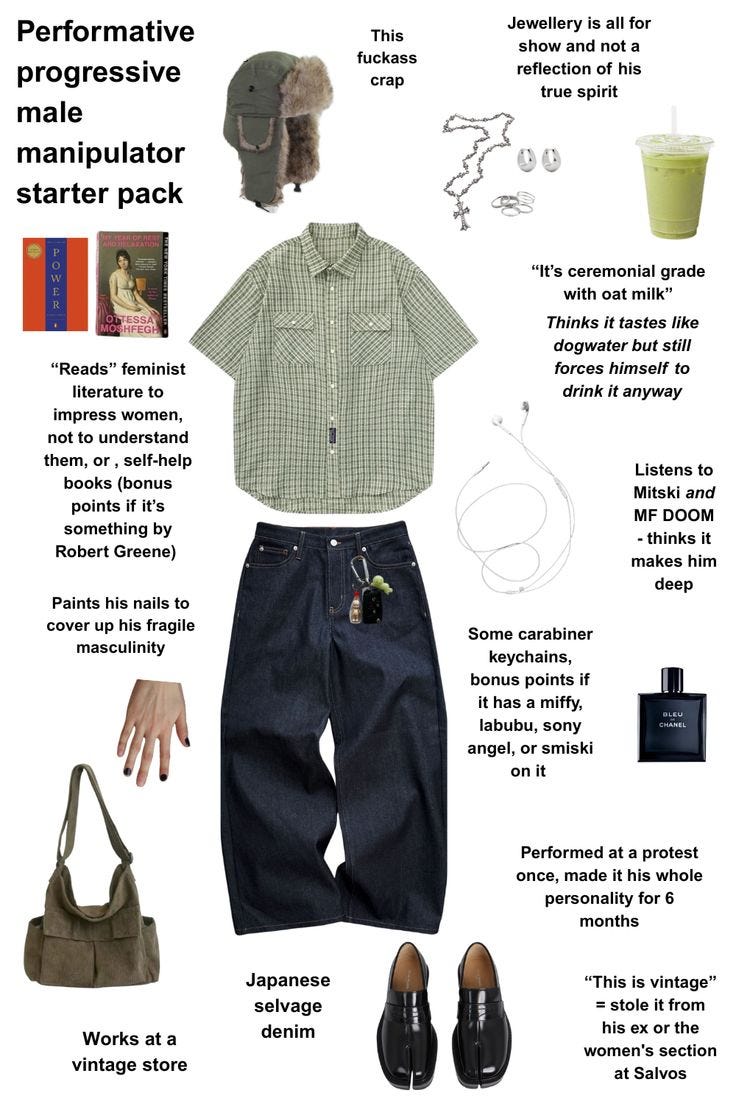
According to this online narrative, a performative man is one who tries excessively hard to distance himself from traditional masculinity. He showcases a carefully curated sensitivity: he wears wired headphones, drinks matcha instead of coffee, reads poetry or books conspicuously in public, listens to “niche” or overly curated music—often with Mitski as his top Spotify artist—and, most importantly, presents himself as a strong supporter of women’s rights. He becomes the “ideal” man, one with no trace of toxic masculinity running through his veins.
But the core question remains: why would a man feel pressured to pretend in order to be appealing to a woman?
The answer lies in the confusion surrounding modern masculinity. Traditional masculinity has—rightfully—been heavily criticized, yet it has not been replaced with a clear, stable, and realistic alternative. Many men, afraid of being labeled “toxic,” “outdated,” or “dangerous,” resort to copying behaviors they believe are socially safe and widely approved. Instead of genuinely developing empathy or emotional intelligence, they perform them.
What do they gain from this? In the short term, validation, acceptance, and the reassurance that they belong to the “right” side. In the long term, however, the cost is authenticity. When sensitivity becomes a tool rather than a way of being, it loses its substance. And when someone pretends in order to be loved, they never leave room to be loved for who they truly are.
So the issue is not that a man drinks matcha, reads poetry, or supports women’s rights. The issue is when these traits are not personal choices but calculated strategies. Not expressions of identity, but performances. And no performance can last forever without eventually collapsing.

Let’s examine, step by step, where this desire comes from.
Modern men seem to be operating within a state of double uncertainty. On one hand, the traditional model of masculinity—silent, dominant, emotionally restrained—is increasingly being questioned and dismantled. On the other, men are now encouraged to show sensitivity, emotional openness, and empathy. However, instead of these traits being developed in an authentic and internal way, some men adopt them superficially, treating them as roles to perform in order to meet social and romantic expectations.
By analyzing the phenomenon more deeply, we come to the conclusion that R. W. Connell’s theory of hegemonic masculinity provides answers to the questions previously raised. What do we mean by this? You may reasonably ask as a reader. Until recently, male identity was directly associated with notions of power and conquest. However, within today’s social framework, we observe that this deeply patriarchal construct is gradually being dismantled. On the contrary, in the contemporary era, the hegemonic ideal undergoes a complete transformation, overturning the stereotypes of the past. Thus, the hegemonic ideal is now presented as a man who is emotionally articulate and expressive.
Having clarified this phenomenon, I believe that the answer to the earlier questions becomes increasingly predictable. The fear of rejection, combined with the desire for control, can often lead to a crisis of identity. The need people—and men in particular—feel to perform a progressive persona by assuming a role rather than embodying genuine change clearly demonstrates a reluctance toward inner reflection and self-improvement. After all, it seems preferable to pretend in order to avoid being labeled as “toxic,” rather than confront the raw and uncomfortable truth of reality—isn’t that so?
Speaking of the essential core of these issues, I would like to position myself more directly on the matter and reflect together on the ultimate meaning of human relationships, when they are built upon artificial and self-serving personas.
We all know that relationships built on false beliefs and performative behaviors tend to crumble at the first sign of trouble—like those expensive silverware sets at your grandmother’s house, shattered into a thousand pieces when you were playing ball in the living room.
All of us, regardless of gender, have at some point broken something at our grandmother’s house—and in much the same way, we’ve put on a persona to be liked by a partner. In doing so, the very essence of human connection is lost, as intimacy is no longer grounded in truth, but in an image we carefully present.
Partners find themselves unable to reveal their true selves, to express their thoughts honestly, because doing so requires the uncomfortable—some might even say painful—exposure of emotions, along with the inevitable risk, conflict, and truth that come with it. The fear of showing who we really are becomes the first necessary brick in the shaky foundation of what should have been genuine connection.
If love requires being seen, then the question remains: love is to be seen—but are we ready to be loved as we truly are, without filters, without roles, without guarantees?
P.S: I love Jacob Elordi… honestly , the perfomative man of my dreams.
—First of all, I really like the way you express yourself. You have a very nice way of speaking, proper use of language and structure, something that makes me want to read your text again and again, pause to understand what you mean, and then form my own thoughts on it. This whole feeling puts me in the process of taking a position, and I will do so.
I originally wrote this text in Greek and then asked my close friend, ChatGPT, to translate it for a better expression of my thoughts.
Getting into the topic, I want to say that I started questioning whether I am a performative man myself, since I don’t feel like I follow any specific masculinity stereotype, but rather do whatever comes to my mind depending on how I feel, weighing situations (not always successfully, but none of us is perfect). Yes, of course I have pretended at times, like all of us, and I dare say that this is normal to a certain extent.
Moving past what I am or am not, and going deeper, relationships are complex by nature, and in this era of “freedom,” with the level we have reached in interpersonal relationships and in the field of psychology (and not only this field), it feels somewhat shallow to judge behaviors in such a simplified way without even knowing the other person’s story—even if, at the end of the day, you might be right in identifying a performative behavior. Among all the negatives of being performative, I would also like to point out that there are some positives. I will come back to this shortly.
A break to breathe
My brother used to tell me all the time:
“You don’t know what you don’t know.”
I understand the way you analyze this phenomenon, and personally I focus on one part of your article without underestimating any of it. Essentially, I’m not judging it, but describing a way of thinking that avoids prejudice, and I explain why below. I don’t disagree with anything you say—even though I’m in the same page with your sayings. The point is that it just doesn’t concern me whether someone fits the performative TikTok stereotype, and it doesn’t affect me in any way, unlike someone who pretends in order to harm or deceive others in any way. You’re not saying something different—this has existed, exists, and will continue to exist. For such behaviors, I will invest emotional and physical energy to think-feel-act. But in the other case, I don’t really care whether you genuinely like adidas samba or whether you listen to Frank Ocean and Esdeekid because you truly enjoy them or because they are trending and place you in a certain “social category” that you want to feel part of. I simply acknowledge it as something acceptable and move on.
In general, you can see how difficult it is to open up. There is endless stress, and almost forced socialization so as not to end up marginalized. You are judged for the smallest things, while in many societies even things that, considering how far humanity has come, should be considered given, are still being questioned. In a world where we communicate all day, every day, yet because of the pace of life, fear, socio-economic structures, and many stereotypes, it is difficult to build meaningful relationships. We have superficial connections, especially through social media, where we present a version of our lives—the one we choose to show. We are under pressure from everywhere. This is not an excuse, of course, but an explanation of behavior.
At the same time, since you mentioned Raewyn Connell and hegemonic masculinity, i find myself agreeing, as it explains why in each period and society an ideal model of man is constructed.
Within all this, we are trying to figure out who we are and how we appear, whether we align with social standards or not, depending on how we feel and who we are. Some things change over time. Some, however, remain objective, and I refer to the fact that we are social beings, and at some point in our lives we choose how to behave based on where and how we grew up, what we lacked, what we perceived, what we need to hear, and so on. To not become tiring, personally I love that nowadays everyone can do whatever they want (one of the positives of our era, even though I also value the Platon’s perspective of on excessive freedom), whether that means adopting a persona one day and being themselves the next, or becoming something else entirely to achieve something.Whether it is waking up and going alone to meditate on a rock at the Acropolis, or anything else your imagination can reach.
But there is one rule for me. Do whatever you want as long as you don’t affect negatively the person next to you. That is one of my core principles that I’m trying every day to stay 100% there
Another breath
I don’t believe in a human utopia.
When you test yourself and expose yourself to so many stimuli, you eventually reach a point where you get to know yourself to the fullest.
That is the fine line.
We have almost everything accessible today, yet at the same time, nothing.
Yes, I am philosophizing and drawing a parallel between meaningful communication and the shallow, everyday, mundane communication we all engage in for countless reasons. I won’t elaborate further—I’ll leave it open.
My advice to anyone?
—Filter how you choose to see life. Judge this phenomenon—and any other you like—question it, absorb it, just as you already did with this one , but without letting it influence how you perceive, in this case, a man who is trying to escape stereotypes and experiment with whatever he wants. If you don’t vibe , then you don’t vibe. At the end of the day, he does what he wants, and the responsibility is in his hands.
What matters to me is communication, and that happens when we truly listen to each other.
As you said, if love requires being truly seen, then let us expose our real selves and thoughts. Either way, we will be judged. That doesn’t feel right to me and that’s why I don’t like to judge someone based only on our own perspective and reality when they haven’t even opened up to us.
Who gives us the access to believe we are correct to think we know when we don’t ?
This is my approach, which keeps me one step back from getting too involved with criticising other people. I may have drifted a bit from the topic.
Still, I felt offended for a bit—as I said at the beginning—not because I see myself as performative, but because I feel very different from the masses. I strive to be myself constantly, not to be influenced by criticism, to try new things in order to discover who I am, without feeling guided by trends or temporary situations. Even through these temporary experiments, you can gain something that helps shape your character. We are constantly evolving beings.Ultimately, I want to support anyone—even someone who pretends to be liked—because in the end, they might be going through the worst phase of their life.
-Ideally, right now, I would like it to be a summer noon and go have a “green grass” aka matcha, alone, at my usual spot, with wired headphones and a book I haven’t touched in months, just to see how people would look at me :) I don’t think I will change the way I see the world.
After all this expression of thoughts, I think the time is getting close for me to post an article on this platform :)